

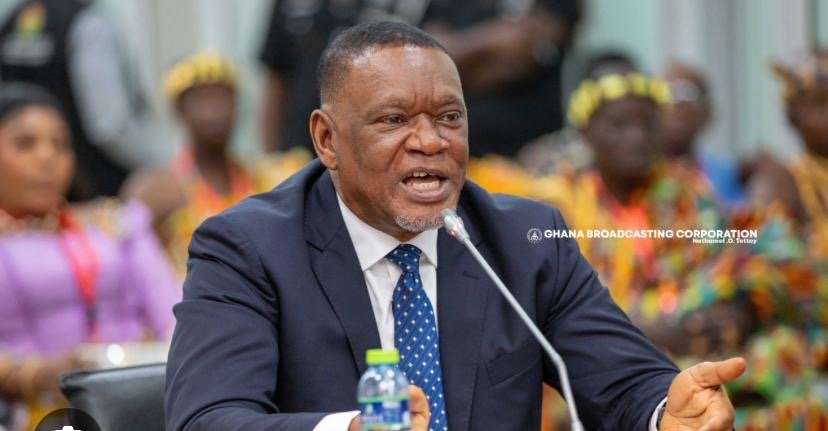
A biography of a distinguished Ghanaian jurist, judicial leader and advocate for reforms in justice delivery.
Justice Senyo Dzamefe is a Ghanaian jurist whose career reflects decades of service to the administration of justice and the development of Ghana’s judicial system. From his early beginnings in the Volta Region to his elevation to the Supreme Court of Ghana in July 2025, his professional journey has taken him through several levels of the judiciary.
Before his appointment to the country’s highest court, he served as a Justice of the Court of Appeal, a High Court judge and a leader of the Association of Magistrates and Judges of Ghana (AMJG). His career has also involved judicial administration, legal reform discussions and participation in significant national inquiries.
Early life and educational background
Born in the Volta Region of Ghana, Justice Dzamefe is the son of the late Rev. Henry Esau Dzamefe and Mrs. Edith Patricia Dzamefe of Agogoe Lume, near Ho. His formative years were shaped by his family background and education, including the influence of his father, a Reverend Pastor in the Evangelical Presbyterian Church.
He began his elementary education at Ho-Kpodzi Evangelical Presbyterian School before proceeding to Hohoe Evangelical Presbyterian Secondary School. He subsequently attended Jasikan Training College, now Jasikan College of Education, before pursuing legal studies at the University of Ghana, Legon. He obtained his Bachelor of Laws (LLB) degree in 1982, proceeded to the Ghana School of Law and was called to the Ghana Bar in 1984. He later pursued further studies in Norway, earning a Master of Business Administration (MBA) in Management and Leadership.
A career spanning decades in the judiciary
Justice Dzamefe began his professional career through National Service at the Attorney-General’s Department in Ho, where he worked under the supervision of Mrs. Sophia Adinyira, a retired Justice of the Supreme Court. After spending some time in the United Kingdom, he returned to Ghana and joined the then National Public Tribunal in 1988 as a Tribunal Chairman. His early judicial assignments included presiding over the Tema Public Tribunal and serving as a visiting Chairman of the Wa Public Tribunal.
Following the integration of the tribunal system into the mainstream Judiciary in 1994, he joined the Judicial Service as Chairman of the Koforidua Circuit Tribunal. His appointment as a High Court judge in 2000 marked a major milestone in his career, making him one of the first two Tribunal Chairmen to transition to the mainstream High Court. He served at the High Courts in Sekondi and Swedru before being posted to Accra in 2008, where he presided over the Fast Track High Court. In 2010, he was elevated to the Court of Appeal, where he served for approximately 15 years before his appointment to the Supreme Court.
Leadership and contribution to judicial administration
Beyond his judicial duties, Justice Dzamefe has played important roles in the administration and governance of Ghana’s judicial system. He served as Vice-President of the Association of Magistrates and Judges of Ghana before being elected President in 2018, a position he held until 2021. During his tenure, he pledged to promote the welfare of judges and magistrates while advancing judicial independence, the rule of law and the effective administration of justice.
He also served on key judicial bodies, including the Judicial Council, the Judiciary’s Disciplinary Committee and the Rules of Court Committee. His professional engagements extended beyond Ghana through participation in activities of the Commonwealth Magistrates and Judges Association. He was also involved in the local organising committee for the association’s 19th Triennial Conference, hosted in Accra in September 2022. These responsibilities placed him at the intersection of judicial leadership, institutional administration and efforts to strengthen public confidence in the justice system.
Chairmanship of the 2014 World Cup Commission of Inquiry
Justice Dzamefe also became widely known nationally for chairing the Commission of Inquiry established to investigate Ghana’s campaign at the 2014 FIFA World Cup in Brazil. The commission examined the circumstances surrounding the Black Stars’ performance and the controversies involving the management of the national team, including financial and administrative arrangements.
The commission’s work generated national discussion about accountability, sports administration and the use of public resources in football. Among the recommendations associated with its findings were proposals to include at least three Ghana-based players in future Black Stars squads, discontinue state-sponsored travel for football supporters and avoid transporting cash to players. The inquiry added a significant public-service dimension to Justice Dzamefe’s career, demonstrating his involvement in a nationally consequential investigation beyond the ordinary work of the courts.
Appointment to the Supreme Court of Ghana
In April 2025, President John Dramani Mahama nominated Justice Dzamefe for appointment to the Supreme Court as part of a group of seven Court of Appeal justices. Following parliamentary vetting and approval, he was sworn into office on 3 July 2025 at the Jubilee House in Accra, formally joining Ghana’s highest court. His elevation followed a lengthy judicial career that included service at the tribunal, High Court and Court of Appeal levels.
During his parliamentary vetting on 16 June 2025, Justice Dzamefe outlined proposals aimed at improving the efficiency, accessibility and integrity of the judicial system. He advocated setting timelines for the resolution of cases, proposing three months for criminal cases and six months for civil cases, while acknowledging the need for adequate resources and infrastructure to make such targets achievable. He also supported expanding virtual court proceedings, adopting technologies such as artificial intelligence for courtroom transcription and establishing additional courts to ease caseload pressures.
His comments during the vetting also addressed judicial ethics, transparency and press freedom. He emphasised that judges should base their decisions on evidence and facts, maintain political neutrality and uphold judicial independence. He affirmed the importance of asset declaration by public officers and supported investigative journalism conducted truthfully and in the public interest. These positions highlighted his stated priorities of accountability, institutional integrity and public confidence in the administration of justice.
At his swearing-in ceremony, Justice Dzamefe spoke on behalf of his newly appointed colleagues and pledged that they would administer justice to all manner of persons without fear, favour, affection or ill will. His remarks underscored the constitutional responsibility entrusted to the Supreme Court and the importance of impartial adjudication in protecting the rights of citizens and upholding the rule of law.
Personal interests and legacy
Outside his professional responsibilities, Justice Dzamefe enjoys exercising and is a supporter of Liverpool Football Club. Although his career has largely been defined by the demands of judicial service, his background reflects a combination of legal education, leadership experience and participation in public inquiries.
Justice Senyo Dzamefe’s journey from the Volta Region to the Supreme Court represents a significant chapter in his professional life. His progression through Ghana’s judicial hierarchy, leadership of the Association of Magistrates and Judges of Ghana, chairmanship of the 2014 World Cup Commission of Inquiry and appointment to the nation’s highest court form the central pillars of his public record. As a Justice of the Supreme Court, his continuing responsibility is to interpret and apply the law in accordance with the Constitution, safeguard judicial independence and contribute to the fair and effective administration of justice in Ghana




Comments
No comments yet. Be the first to share your thoughts!
Leave a Comment