

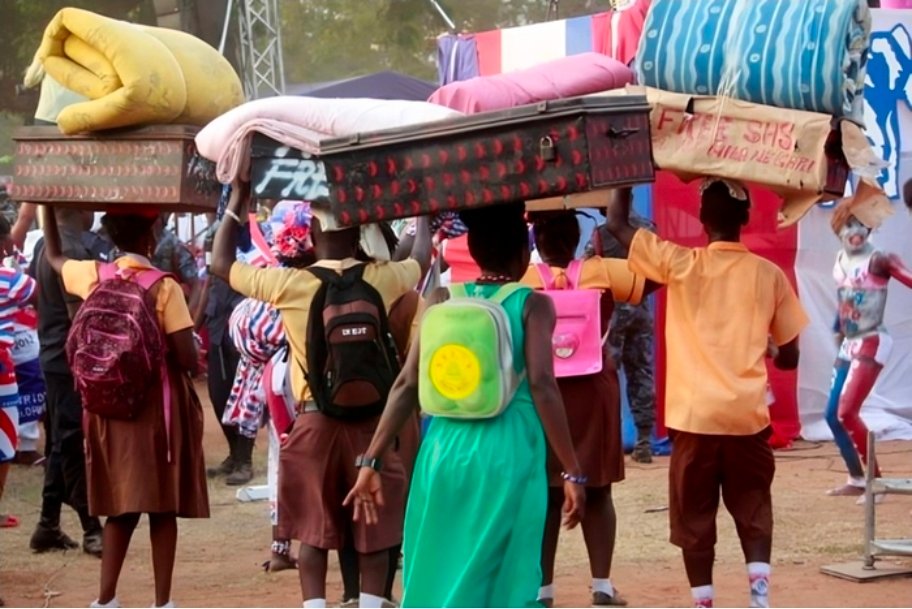
The Government of Ghana has allocated GH¢1.37 billion in the 2027 Budget to overhaul secondary education and abolish the double-track system, alongside GH¢537 million to fund the No Fees Stress Policy for first-year public tertiary students. Presenting the 2027 Budget Statement and Economic Policy to Parliament on Thursday, November 12, Finance Minister Dr. Cassiel Ato Forson outlined these major investments as part of an overall GH¢48 billion allocation to the Ministry of Education aimed at expanding access and improving teaching and learning across the country.
Eliminating the double-track arrangement fulfills a central 2024 campaign pledge by the National Democratic Congress (NDC) to restore a stable, unified academic calendar for senior high schools. To achieve this transition, the government plans to expand infrastructure within existing secondary institutions and complete abandoned Community Day Senior High School (E-block) projects. Backing this broad infrastructural drive is a massive GH¢11.2 billion earmark for the Ghana Education Trust Fund (GETFund) to accelerate physical development across the educational sector.
At the tertiary level, the GH¢537 million allocation for the No Fees Stress Policy builds upon the GH¢499.8 million provided in the 2025 Budget. Originally launched by President John Dramani Mahama in July 2025, the initiative relieves financial pressure on incoming students by covering the academic-related fees of all first-year entrants into public tertiary institutions. In addition, the Scholarship Secretariat has received a separate allocation of GH¢250 million to continue executing its mandate of providing financial assistance to needy and brilliant students.
Beyond secondary and tertiary reforms, the 2027 fiscal plan directs substantial funding toward basic education and student welfare. The government has earmarked GH¢292 million for the distribution of free sanitary pads to boost girls' school attendance and participation, alongside GH¢227 million for teacher trainee allowances. Basic schools will also benefit from GH¢169 million set aside to absorb Basic Education Certificate Examination (BECE) registration fees and GH¢166 million dedicated to the Capitation Grant.
To ensure inclusivity and operational continuity across the sector, an additional GH¢133 million will sustain existing educational interventions, while GH¢50 million has been specifically dedicated to special schools supporting learners with specialised needs. Together, these targeted allocations underscore the administration's strategy to strengthen foundational learning, remove financial barriers at every tier of education, and stabilize the national academic calendar in 2027.
@Volta Today


Comments
No comments yet. Be the first to share your thoughts!
Leave a Comment